

CHILI CRISP: A killer condiment
Updated: Feb 23
Just in time for Lunar New Year celebrations — the Year of the Fire Horse — here's a look at the fiery Asian sauce you need now!

By CINDA CHAVICH
I’m not sure when I first encountered “chili crisp”, but I know it’s a spicy condiment that’s long been ubiquitous in Asian restaurants, whether spooned over dim sum dumplings or into big bowls of Pho noodle soups.
Before it was “chili crisp” or “chili crunch” — the modern social media sensation — it was simply the fried chili oil, sitting in a covered glass dish on the Formica table next to the soy sauce and paper-packets of disposable chopsticks, something probably made in the restaurant kitchen.
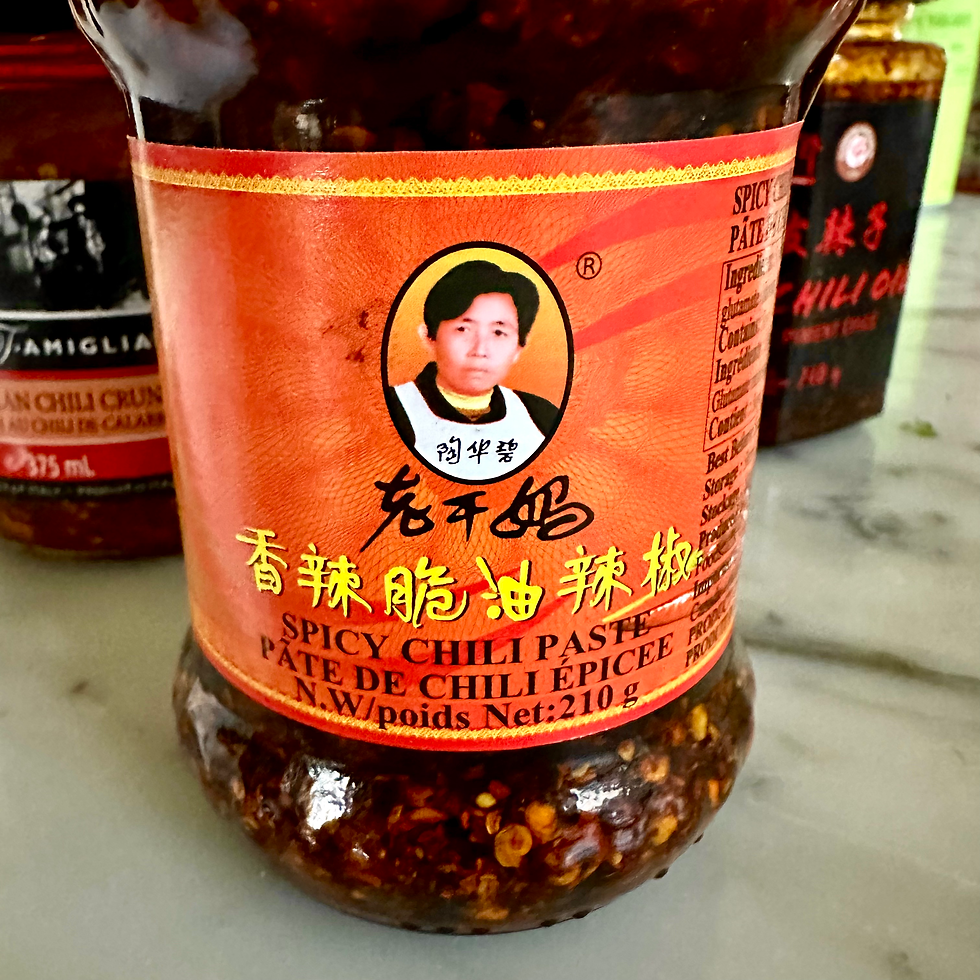
These days it’s the jar of Chinese Lao Gan Ma brand (“old mother”) sauce that’s getting all the buzz. It’s the one from Guizhou province, with the sage looking grandmother peering out from the label, that’s suddenly sold around the world, and literally on everyone’s lips.
The Lao Gan Ma (LGM) chili crisp is more than just crunchy dried chilies in oil. It is an addictive combination of dried chilies, crunchy fried garlic and onions, with black beans in soybean oil that’s savoury and salty, a little sweet, and spicy, but not extremely so, despite being an almost solid mixture of chili flakes in oil.
A little goes a long way, and I find myself scattering a spoonful over all kinds of things, from ramen to stir fries and pasta dishes or curries.
While I always have a big jar of hot garlic chili sauce (with the rooster logo and the green lid) in my fridge — the essential spicy ingredient for everything from stir fries and soups to pasta sauces and dips — chili crisp is the perfect final flourish, like a bit of coarse sea salt to finish many dishes and boost the heat.

CHILI OIL, CRUNCH OR CRISP?
What’s in a name? While there’s are “chili oil”, “chili crunch” and “chili crisp” products in the market they are similar, and often interchangeable, though somewhat different, depending on the brand.
Chili oils are usually made with dried chilies and oil, nothing else, while chili crisp or crunch includes crunchy dried chilies, dried garlic, crispy onions, fermented black beans, salt, sugar and even peanuts, sesame seeds, roasted soy beans and Sichuan peppercorns.

When I went out to search our local supermarkets recently, I found several different versions of the chili crisp/oil products from several Asian producers and some upscale locally-made products. There’s also an Italian style Calabrian Chili Crisp with the most basic ingredients (sunflower oil, dried onion, dried garlic, bruised chili pepper and salt) and the lowest fat and calories per tablespoon (1 g fat and 15 calories). While it’s likely a “lost in translation” moment, the LGN chili crisp label states that 4 tsp (60 g) contains 43 g of fat and 440 calories (hoping it’s a misplaced decimal point!).
WHAT’S IN THE JAR?

The “grandmother” LGM brand, made in China, offers Spicy Chili Crisp, Chicken Flavour Chili Oil, Chili Oil with Fermented Soybean, Fried Chili in Oil, Spicy Bean Paste Sauce, among others (which all actually look pretty much the same in the jar — you’ll have to read the fine print).
There’s Galanlang Spicy Chili Oil in a distinctive six-sided jar. All in the $4-$7 range, with the usual Chinese condiment ingredients including “flavour enhancer” (aka monosodium glutamate/MSG). Some brands contain sesame seeds or peanuts for crunch, too.
There’s a Japanese version — S&B Crunchy Garlic with Chili Oil — with tons of crunchy roasted garlic chips in the mix (along with sesame, soy sauce and MSG). And celeb chef David Chang of Momofuku has his own Momofuku Chili Crunch, hot and spicy with umami from shiitake mushroom powder (natural MSG), plus a swanky Black Truffle Chili Crunch and a sweet+spicy Chili Crunch Hot Honey.
MADE IN CANADA
If you want a unique, MSG-free, local, Vancouver-made version of chili oil, there’s Holy Duck Chili Oil (made with Canadian rendered duck fat), in regular and Extra Ducking (extra spicy) or Zero Ducks (vegan) versions. There’s even one made with Lion’s Mane mushrooms, which seems appropriate for a Lunar New Year celebration. All include the crispy garlic and shallots, triple fried in duck fat, which add the crunch and umami that makes chili crisp such a revelation.
There’s also an MSG-free Super Magic Taste brand of Chili Crisp made in Toronto, with Gochugaru chili peppers, onions, garlic, almonds, sesame, soy, sugar, and sunflower oil.
And from here on Vancouver Island, there’s Umami Bomb from Vumami Foods, a shiitake mushroom based chili oil with garlic and fermented black beans — a tasty chili condiment with loads of umami but minus the crunch.
I’ve even found chili crisp in my favourite Mediterranean deli — the La Famiglia brand’s Calabrian Chili Crunch (aka La Bomba) is made with hot Calabrian peppers, dried garlic, dried onion, salt and sunflower oil (no MSG in sight), and has just 15 calories per tablespoon. Add it to your puttanesca sauce or drizzle it on a pizza, anything Italian that needs a little extra heat.

COOKING WITH THE CRISP
Chili crisp is a go-to condiment for Chinese dumplings or noodle dishes, and perfect for spicy Ma Po Tofu, but you don’t have to relegate chili crisp to Asian food. Think about spooning it over a whole brie before baking, tossing it with roasted vegetables, or drizzling it over your avocado toast. Put it into a marinade for chicken or pork, stir it into a pot of steamed rice, add it to a spicy salad dressing, or a tomato sauce for pasta. I haven’t tried it yet but some cooks swear by frying eggs in chili crisp. Others eat their fried chicken and biscuits with chili crisp.
If you’re ambitious, you can gather the ingredients (from various dried chilies and Sichuan spices to dried garlic and crispy fried onions) to make your own chili crisp — you’ll find many recipes online. But today chili crisp is so popular, you will probably find a brand you like at your local supermarket.
Once you open a jar, it will be hard to put it down. No wonder chili crisp is the new ketchup!

RECIPES:
CHILI CRISP NOODLES
One of my favourite food and recipe writers is Aussie author Nagi Maehashi. I love reading her online recipes at Recipe Tin Eats and her best-selling books — Recipe Tin Eats Dinner and Recipe Tin Eats Tonight — both have pride of place in my cookbook collection.
Here’s her quick and easy version of Dan Dan Noodles made with chili crisp to add “firecracker crunch” to your dinner, a dish she says can be ready in just 7 minutes!
As always, Nagi includes great instructions in her recipes, with notes to answer all of your questions.
Easy, peasy — cheap and cheerful — you can even make her recipe with instant ramen noodles. Augment this simple noodle dish with additions like vegetables (bok choy, bean sprouts, etc.) or protein (cooked chicken, pork, crispy sauteed tofu, shrimp or a soft-cooked egg).
2 tbsp Chinese sesame paste (Note 1 subs)
2 tbsp light soy sauce (Note 2)
1 tbsp rice vinegar (Note 3)
1 tsp white sugar (or other sugar, or honey, maple)
2 tsp sesame oil, toasted (Note 4)
1/8 tsp+ cooking / kosher salt (Note 5)
2 heaped tbsp chilli crisp (get oil + chili bits), Laoganma’s Spicy Chili Oil is Nagi's store-bought go-to, her personal favourite is Mrs C's Apprentice (from Australia, if you happen to be Down Under) (Note 6)
1 tbsp ginger, finely minced*
1 tbsp garlic, finely minced*
1 green onion stem, finely sliced (or 1/4 red onion finely sliced)
1/3 cup coriander/cilantro, roughly chopped*
Noodle options (Note 7):
140g/ 5oz (2 cakes) instant noodles / ramen noodles
250g/8oz fresh noodles (like hokkien, lo mein)
Instructions
CHECK the spiciness of your chilli crisp - taste it!! Laoganma is not actually that spicy (most store bought brands she has used are similar) and the quantity used is based on that brand. If yours is very spicy, start with less and add more later.
Base sauce — Mix the sesame oil, vinegar, soy, sugar, salt and sesame paste in a bowl. Top with green onion (don’t mix in).
Sizzling chili crisp — Heat chilli crisp and oil in a small pan over medium heat. Add ginger and garlic, stir 30 seconds until golden and it smells amazing. Pour over green onion - enjoy the sizzle! Then mix.
Toss — Cook noodles per packet directions. Drag the noodles straight from the saucepan into the bowl (extra water loosens the sauce). Toss. Use cooking water to loosen more if needed. Toss through coriander/cilantro.
Adjust & finish — Taste. Add more salt if needed and more chilli crisp if desired (not all chilli crisp is the same saltiness / spiciness). Eat!
Notes
* Optional. Makes it better, but still worth making without!
1. Chinese sesame paste (not to be confused with Chinese sesame sauce which is not as intense) has more intense sesame flavour than tahini. Available at Asian stores and some large grocery stores. Sub with tahini or pure unsalted peanut butter with an extra dash of sesame oil at the end.
Commercial peanut butter spread (eg Jif or Kraft) will also work but has the least flavour.
2. Soy — Or all-purpose soy or half the amount of dark soy sauce (sauce colour will be darker)
3. Vinegar subs — or apple cider vinegar or other clear vinegar)
4. Toasted sesame oil is brown and has more flavour than untoasted (which is yellow). Default sesame oil (sold in Australia) is toasted, un-toasted is harder to find.
5. Salt — Not all chili crisp has the same level of saltiness. Laoganma’s Spicy Chili Crisp (which Nagi uses) is quite salty. If you use homemade, you'll probably need more salt.
6. Chili crisp — Chili oil with crispy bits of chili of varying levels of spiciness. Her go-to: Laoganma’s Spicy Chili Oil, a worldwide favourite, not that spicy. Sweet, salty balance, and excellent crunch factor with extra from soy beans. Sold at larger grocery stores + Asian stores (in Australia and Canada). Excellent flavour, A$4 for 200g/7oz jar ($4-$5 Cdn)
Use the crispy chili bits plus some oil for frying up the chili, ginger and garlic. If you're short on oil from the jar, add a drizzle of oil.
Make your own — try the Serious Eats or Chili Pepper Madness recipes for "real" ones, or Marion's Kitchen for a quick one.
7. Noodles — Nagi likes using ramen / instant noodles because the crispy chili bits get tangled up in the curls. But any noodles will work here — same weight per ingredients list for other types of dried (like rice or egg noodles) or fresh noodles (i.e. from the refrigerator section ).
Nutrition
Calories: 503cal | Carbohydrates: 51g | Protein: 11g | Fat: 33g | Saturated Fat: 8g | Polyunsaturated Fat: 6g | Monounsaturated Fat: 18g | Sodium: 2556mg | Potassium: 243mg | Fiber: 2g | Sugar: 4g | Vitamin A: 194IU | Vitamin C: 3mg | Calcium: 45mg | Iron: 4mg
MA PO TOFU

Here’s my recipe for Ma Po Tofu, inspired by a food trip to China’s Szechuan province, where we stopped at Mrs. Chen’s famous restaurant in Chengdu, where this classic local dish was created.
The combination of chilies and aromatic ground Szechuan peppercorns will literally make your tongue numb, but the creamy tofu acts as an antidote to the spice.
I’ve updated my recipe — originally published in my book, The Guy Can’t Cook — with chili crisp. Add extra if you want more spice!
1 lb (500 g) package medium-firm silken tofu
½ lb (250 g) ground pork (or beef)
2 Tbsp (30 mL) soy sauce, divided
2 Tbsp (30 mL) rice wine, divided
1 tsp (5 mL) sesame oil
1 Tbsp (15 mL) canola oil
2 green onions, minced, divided
2 cloves garlic, minced
1 tbsp minced ginger
2 tbsp Chili Crisp (or add more to taste)
½ cup (125 mL) chicken broth
½ tsp (2 mL) granulated sugar
½ tsp (2 mL) cornstarch mixed with 2 tsp (10 mL)
cold water
1 tsp (5 mL) Szechuan peppercorns, toasted in a dry pan and crushed to a powder
Wrap the tofu in a clean towel and drain on the counter under a weight (use a heavy saucepan or cutting board), for 15 minutes. Cut into small cubes and set aside.
In a bowl, combine the ground pork with 1 Tbsp (15 mL) of soy sauce, 1 Tbsp (15 mL) of rice wine, and the sesame oil. Set aside to marinate.
In a wok, heat the canola oil over medium-high heat. Add the ground pork and stir-fry for 5 minutes, breaking the meat up into small pieces. When cooked, remove the meat from the wok using a slotted spoon.
Add half the green onions to the wok along with the garlic, ginger, and chili crisp. Stir-fry for 10 seconds before adding the broth, sugar, remaining soy sauce, rice wine, reserved tofu cubes, and cooked pork.
Bring to a boil, reduce the heat to medium, and simmer for 10 minutes or until the liquid is reduced by one quarter. Stir in the cornstarch solution and simmer until thickened.
Serve sprinkled with remaining green onions and Szechuan peppercorn powder. Serves 4.
TIP: The easiest way to peel a gnarly piece of fresh ginger is with a spoon. Really. Just use the sharp edge of a teaspoon to scrape away most of the papery, brown skin. Before you mince, place the whole piece of ginger under the flat blade of your chef’s knife and give it a whack—the ginger will nearly mince itself (the same trick works with whole cloves of garlic).
©CindaChavich2026


Comments